Thursday, October 13, 2011

Fall Line Cities and the Ocmulgee Indian Mounds

Fall Lines and Fall Line Cities
Macon, GA is listed as a Fall Line city.  This qualification has many important impacts.  Indigenous peoples would have found this area very useful because of the abundance of fish and other means of nutrition. Fall line cities represent a point where travel by riverboats is not possible anymore.  Riverboats began traveling and bringing goods into to Georgia at the mouth of the Ocmulgee River around Hazelhurst, GA, on the coast.  They found that the trip was no longer possible around the area that is now Macon.  This is because of the fall line.  A fall line is an area where the hard "basement rock" of the Piedmont transitions to "a softer sedimentary rock." In the past, this was where the ocean met the shoreline of prehistoric North America.  Places like Macon, Columbus, and Augusta (all on different rivers) became the final port for transferring goods into the state by water.  From Macon, goods would be shipped out via land.

This is a picture of the Eastern Seaboard Fall Line with the coast of North Carolina on the right of the picture.  The gray coastal plain transitions into the bright colors of the Piedmont (literally: foot of the mountain).

Ocmulgee National Monument 
We also explored the Ocmulgee National Monument in Macon.  This a place where Native Americans built mounds of Earth that served many different purposes.  The mounds were built by hand by the people of the local Mississippi culture.  The largest (The Great Temple Mound) was built as a plateau that overlooked the town.  Earth lodges were also built for public meetings. Various burial and ceremonial mounds are also present.  According to the National Parks website, this site shows 17,000 years of continuous human presence.

The Great Temple Mound

The Earth Lodge

Sunday, October 2, 2011

Soil Types and Community Gardens

12 Orders of Soil Taxonomy
(links containing maps)

There are 12 orders of soil taxonomy:

  • Gelisols
  • Histosols
  • Spodosols
  • Andisols
  • Oxisols
  • Vertisols
  • Aridisols
  • Ultisols
  • Mollisols
  • Alfisols
  • Inceptisols
  • Entisols
Ultisols
Ultisols are soils found mainly in the southeastern United States, lower west Africa, and south-central Asia.  They are low in nutrients because they are so highly weathered.  Often, ultisols are red in color because of the presence of iron oxides.  The clay-enriched subsoil acts as a storehouse of water for plants.  These soils are found in humid climates and show a dominance of iron and aluminum oxides.

Community Gardens
Community gardens are an important part of many towns and cities.  In a world where urban landscapes dominate, many people have begun creating green-spaces with the hopes of growing fruits, vegetables, and an area where people can enjoy nature.
Macon Roots is a good example of a community garden. Their mission statement:
Macon Roots promotes a diverse, sustainable, and local food system for Middle Georgia.  We promote a sustainable food system in Macon and Middle Georgia by celebrating the local food cultures, supporting food and garden education programs, creating networking opportunities in the local food system, and increasing availability of locally grown food for all Middle Georgians.

In our lab on 9/26, we examined different types of soils.  We used a sieve to sort through all of the textures.  We also added water to the dirt and decided that it was a loamy sand. We determined this by using the following key:


Sunday, September 25, 2011

Nature walk around campus of Mercer University - Bushes

Rhododendron calendulaceum (Azalea)

Phlox adsurgens

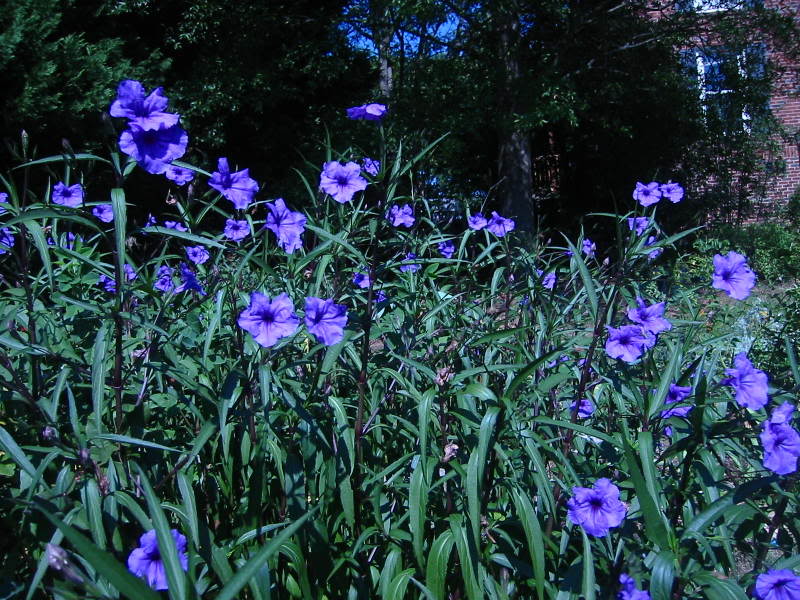
Reullia brittoniana (Mexican petunia)

Brugmansia arborea (Angel trumpets)

Conium chaerophylloides (Hemlock)

Nature walk around campus of Mercer University - Trees

Ginko Bilboa

Betula nigra (River Birch)

Cornus florida (Dogwood)

Magnolia gradiflora

Quercus phellos (Willow oak)

River Map


This is a picture of a section of the Ocmulgee River in Macon. We tested the amount of clams in different parts of the river. We also measured river depth from a starting point at the top of the hill.  Each pin color means something:
Maroon: 0 clams found
Yellow: 1-4 clams found
Green: 5-9 clams found
Orange: clams found, but most or all were dead
Red: elevations of the river from the top of the hill above the river all the way across to the other bank.
The white line is the path of the measurements.  The opaque polygon shows where there is now a high growth of bamboo on the sandbar.

Sunday, September 4, 2011

My Favorite Place

My favorite place is in Baton Rouge, LA when I would take time each day to run the lakes on the campus of LSU. The yellow pushpin is located right in the middle of the bridge on Dalrymple Drive.  This section of my path was always my favorite because there were always other people fishing, running, or just being together. The red line represents my running path. The polygon is City Park Lake that passes under I10 to become University Lake.